
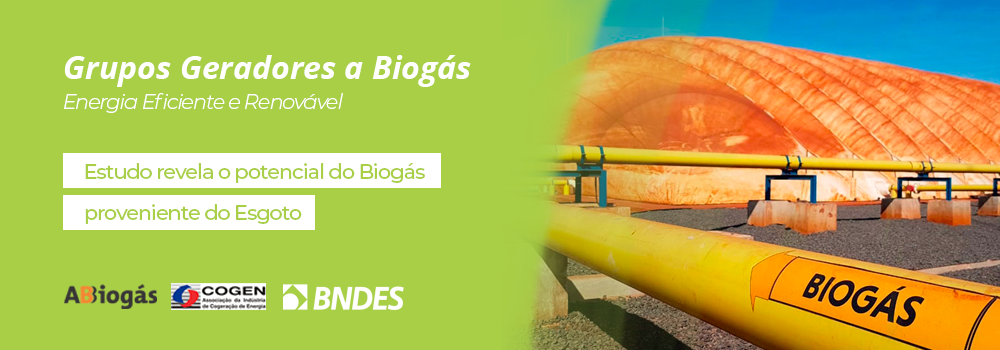
According to a study conducted in partnership with sector entities, coordinated by Abiogás (Brazilian Biogas Association) last year, the national goal of universalizing water and sewage services by 2033, contemplated in the sanitation regulatory framework published in 2020, should increase the potential for biogas generation from sewage treatment by more than 85%.
The generation estimate is based on the expectation that approximately 192 million Brazilians (84.5% of the population) will have their sewage treated by anaerobic routes by 2033, generating biogas as a byproduct that can be used for electricity or thermal energy generation or transformed into biofuel (biomethane) through purification.
In a short-term projection until 2023, the potential would range between 568 million m³ and 692.1 million m³ of biogas/year, depending on the percentage of anaerobic treatment, which would be converted into 1.6 TWh of electricity, 1.8 TWh of thermal energy, or the equivalent of up to 475 million liters of diesel replaced by vehicular biomethane.
Current Potential
Based on consolidated sewage treatment data available from 2019, in which just over 106 million inhabitants are served by sewage collection and treatment networks, the biogas production potential is 493.4 million m³ of biogas. In this case, the Southeast region accounts for 71% of the potential, followed by the South region with 14%.
The potential volume calculated for 2019 could supply 1.18 TWh/year of electricity, representing the annual electricity demand of a city with 587,000 residences, or the generation of approximately 375.5 million m³/year of biomethane, replacing 347.7 million liters of diesel.
Despite this potential, the use of biogas from wastewater treatment plants (WWTPs) comes from only 10 plants installed in Brazil, including 9 WWTPs and one co-digestion plant for sewage sludge and food waste.
About 83% of this biogas volume is used for electricity generation in units with an average installed capacity of 1 MW, generating only 24 MWh of electricity per year in Brazil from WWTPs. For biomethane production, only 4% of the biogas generated in the country by wastewater treatment plants (WWTPs) is used, which corresponds to 912,500 m³/year of biogas. The only plant that purifies biogas from sanitary sewage for biomethane production is owned by the São Paulo state sanitation company, Sabesp, in Franca (SP).
Biogas production continues to rise
Currently, there are 109 medium-sized plants, with annual production between 1 and 5 million Nm³/year, and 51 large-scale plants, producing from 5 to 125 million Nm³/year.
In 2021, the total production of all biogas plants in the country reached 2.3 billion Nm³, more than double the 2017 figure, in a growing trend that saw 2.14 billion in 2020 and is estimated to reach at least 2.8 billion in 2022.
The compiled data for 2021 shows that 102 new plants began operating (a 16% increase compared to 2020) and there was a 10% increase in the volume of biogas produced, with an additional 209 million Nm³.
Minas Gerais and Paraná have the most biogas plants.
In total, 20 states have biogas plants. Minas Gerais, with a total of 251 plants (25 new), and Paraná, with 159 (22 new), lead the ranking of states with the most active plants. Santa Catarina and Goiás registered growth of 28% and 24% in the number of plants in operation, respectively.
In 2021, the first biogas generating units with energy recovery were registered in Alagoas and Rondônia on BiogasMap. The states of Acre, Amapá, Piauí, Rio Grande do Norte, Roraima, and Sergipe remained without any registered biogas plants that perform any type of energy recovery.
Of the 811 biogas plants cataloged, 755 are in operation with energy recovery (93%), 44 are in the implementation phase (5%), and 12 are undergoing reformulation or renovation (2%) and should return to operation in 2022.
In absolute numbers, there was a 20% growth compared to the previous year (675 plants), indicating that the market continues to expand.
The Power of Biogas
Even in a pandemic scenario, with fluctuations in the price of a barrel of oil, the rise in the dollar – which triggered an increase in fuel and LPG prices – and a water crisis, the Brazilian biogas industry remains strong.
According to ABiogás, the development of the national industry of suppliers of goods and services for the biogas sector is growing, and this has helped to reduce the installation costs of biogas and biomethane plants in the country.
Considering the scenario of 2.3 billion cubic meters of biogas generated in 2021 by the 755 plants in operation, Brazil is only exploiting 3% of this potential. However, when considering short-term production potential, that is, taking into account only residues and effluents that do not present obstacles to immediate access within the livestock, industrial, and other supply chains…


